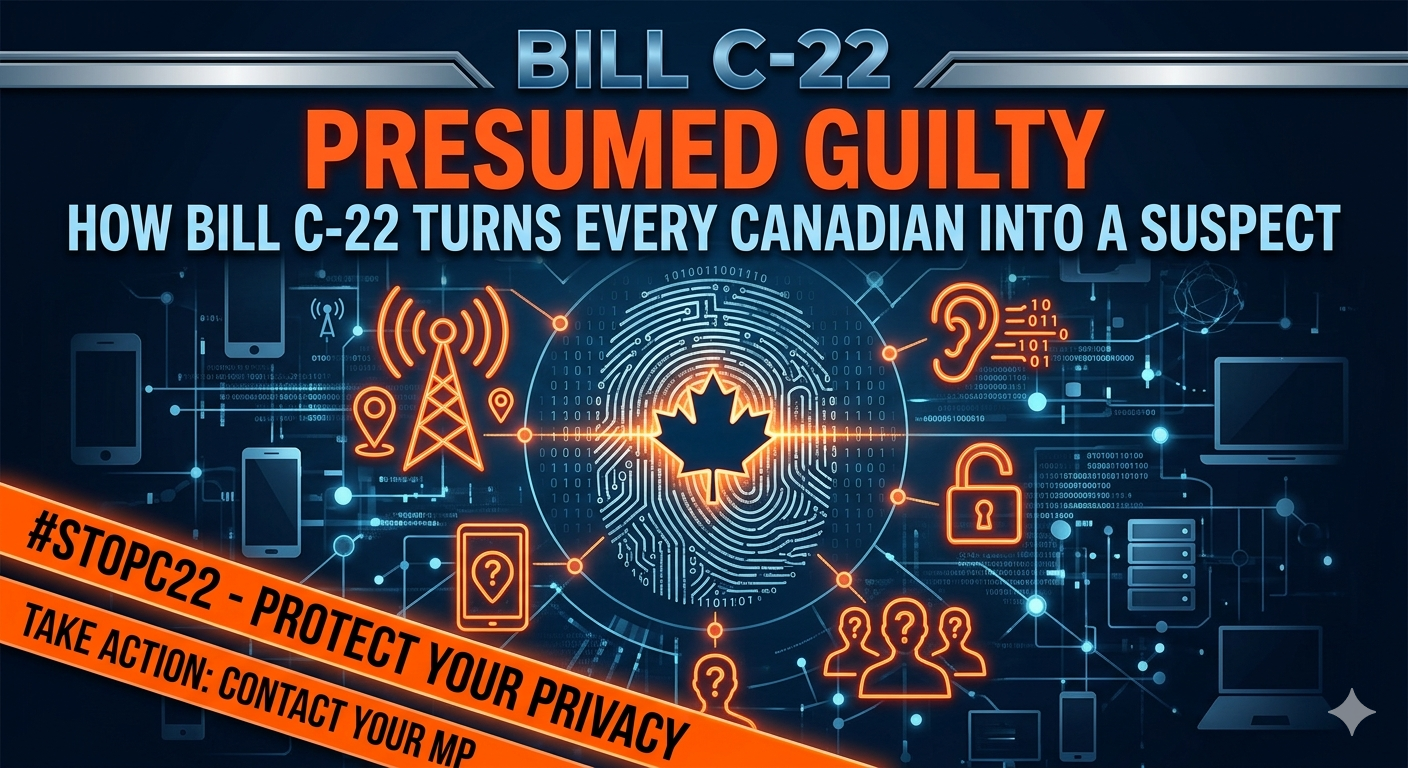
Bill C-22 isn't about targeted policing. It is a population-wide digital dragnet that forces tech companies to store a year of your location and interaction logs. By demanding built-in "backdoors," it threatens to trigger a massive tech exodus out of Canada.
Bill C-22 is a major digital overstep
Instead of targeting specific suspects, the government will force tech companies to keep a log of everything you do, wherever you go and who you communicate with, for every single private Canadian citizen, up to 1 year.
Let's explore what this really is all about and what it means to Canadians and every software/technology manufacturer in the world.
Imagine a world where every technology you use has a back door into personal details about your life that can be hacked, exposed or exploited, all in the name of government surveillance. Sounds like sci-fi? Think again. This is what the Canadian government is trying to do right now, and most Canadians do not truly understand the over-reach and security risk to personal lives this can have.
Welcome to the latest Bill C-22 trying to be passed into law. (Note: this same bill used to be called Bill C-2, but when the Liberal party had a minority government, it got quashed and thrown out). Times have changed, and now that the Liberal government has majority control, the threat has re-surfaced and is like a page out of a horror movie script.
What's worse is that it forces tech companies to break cyber security and encryption technologies to allow the government access (albeit with a court order) any time they want. And guess who ultimately pays for this financially? Initially, the tech companies are out of pocket, but ultimately, you, the one who is giving up everything about your personal life will be paying for the government's overreach.
Many tech giants like Apple, Meta, Signal & NordVPN are already warning of a Canadian tech exodus. We have included links to several articles at the bottom of this blog post for you to do your own homework. This could have a massive economic impact to the Canadian economy, let alone make Canada the laughing stock of the world for being the only G7 country that major tech companies exit for good.
When discussing government surveillance, it is easy to slip into hyperbole. Critics often point to authoritarian regimes to sound the alarm, but we do not need to look abroad to find a threat to our liberties. Sometimes, the most profound structural changes to a democracy happen quietly, framed as "modernization" right here at home.
The federal government’s proposed Lawful Access Act, known as Bill C-22, is exactly that kind of paradigm shift. And we hope to expose why in this blog post.
We are all for law enforcement getting a much-needed update to their tools to tackle complex digital crimes like cyber-extortion and online exploitation, but Bill C-22 fundamentally alters the relationship between the Canadian citizen and the state. It moves the needle from targeted policing to a population-wide digital dragnet.
Here is exactly why Bill C-22 is a major overstep, why it breaks the core security of the internet, and why Canadians should be deeply concerned.
1. Upending the Presumption of Innocence
In a free society, the baseline assumption is that your daily life, movements, and private interactions are your own business unless law enforcement has reasonable grounds to suspect you of a crime.
Under current Canadian and American legal standards, if the police are investigating a specific suspect, they can issue a targeted preservation demand. This forces a telecom provider to freeze that specific person’s data while the officers go to a judge to secure a full search warrant. It is a precise, localized tool.
Bill C-22 throws out this targeted focus. This is the key issue with it that is at the root of much criticism.
Section 5 of the bill introduces a mandatory blanket metadata retention regime. Instead of freezing a suspect's data on demand, it forces electronic service providers to proactively log and store a rolling, 12-month archive of metadata for EVERY SIGNLE CANADIAN, regardless of whether they have done anything wrong.
2. The Danger of the "Metadata" Myth
The Liberal government frequently defends this bill by reminding the public that they aren't intercepting the actual content of your text messages, phone calls, or social media posts. They claim they are "just" collecting metadata.
This is a dangerous distinction. Modern metadata includes your device identifiers, timestamps, connection logs, and crucially, your continuous location data.
If a third-party can look back through 365 days of your cell tower pings and IP logs, they don't need to read your texts. They know exactly where you sleep, what route you drive to work, what medical clinics you visit, who you meet with, what political rallies you attend, and what time you wake up. It creates a flawless, permanent behavioral map of your entire life.
In recent parliamentary committee hearings, law enforcement officials explicitly confirmed that this data would be used as a dragnet. The RCMP argued that having a year-long archive would allow them to retroactively identify everyone who happened to be in the vicinity of a crime scene. Treating thousands of innocent bystanders as data points to be mined is the absolute definition of an overstep.
3. Breaking Cybersecurity with "Backdoors"
The second major flaw in Bill C-22 is its technical capability mandates. The bill grants the government the power to issue sweeping, sometimes secret ministerial orders forcing tech companies to build data-extraction tools directly into their systems.
The definition of an "electronic service provider" in the bill is incredibly broad. It scopes in not just major telecom monopolies like Rogers and Bell, but device manufacturers, cloud storage firms, secure messaging apps, and VPN providers.
For privacy-centric platforms, this poses an existential threat. End-to-end encrypted messaging apps (like Signal) and zero-log virtual private networks (like NordVPN or Windscribe) are secure precisely because the companies themselves cannot see your data.
To comply with Bill C-22, these companies would be forced to re-engineer their software to build interception capabilities. Security experts around the globe agree on a fundamental truth: there is no such thing as a backdoor that only lets the "good guys" in. Once an entry point or data extraction feature is coded into an application, that vulnerability can be discovered, leaked, and exploited by cybercriminals, rogue actors, or hostile foreign intelligence states.
4. The Impending Canadian Tech Exodus
The tech sector isn't bluffing, and they aren't misreading the bill. Privacy and security giants (including Apple, Meta, Signal, and major VPN networks) have already raised the alarm. Many have warned that if Bill C-22 passes without severe amendments, they will be forced to pull their services out of Canada entirely rather than compromise the global integrity of their security architectures.
Trust is the foundational currency of the digital economy. We cannot market Canada as a world-class hub for tech, artificial intelligence, and cloud innovation while simultaneously legislating a continuous, nationwide digital dragnet. It will dry up international venture capital, stifle domestic startups, and isolate Canadian consumers from the world's most secure digital tools.
It is important for all Canadians to educate themselves when it comes to what Bill C-22 really means to us as individuals, our children, our businesses and our livelihoods. The amount of power that this bill will render to the government is truly anti-democratic and sets the precedent to pave the way to Canada becoming another surveillance state like some other countries that are frowned upon by democratic mentalities.
Yet the government is hiding their true intent and dismissing allegations.
Do Your Own Research
Don't take my word for it. Review the active debates, legal briefs, and expert analyses surrounding Bill C-22 to understand the full scope of what is at stake:
It is time for Canadians and technology providers to do their due diligence, educate ourselves on the lasting impact of such drastic bills, and write to our MP's to put a stop to the nonsense.
Here is a great place to start.
If you want to read more about what many tech companies are saying, we've included those links for your reference:
Canada Bill C-22: https://www.parl.ca/legisinfo/en/bill/44-1/c-22
Open Parliament Readings: https://openparliament.ca/bills/45-1/C-22/
Public Safety Canada's Justification Article: https://www.canada.ca/en/public-safety-canada/news/2026/03/backgrounder--securing-access-to-information-in-bill-c-22.html
Michael Geist, Legal Expert: https://www.michaelgeist.ca/2026/05/the-lawful-access-two-headed-surveillance-monster-how-bill-c-22-went-off-the-rails/
C-22: Canada's Backdoor Access: https://www.michaelgeist.ca/2026/05/the-lawful-access-two-headed-surveillance-monster-how-bill-c-22-went-off-the-rails/
Meta: https://about.fb.com/news/2026/05/metas-position-on-canadas-bill-c-22/
Apple and Meta: https://www.reuters.com/legal/litigation/apple-warns-canadian-bill-could-force-it-weaken-device-encryption-2026-05-07/
The Hub: https://thehub.ca/2026/05/22/why-the-liberal-governments-bill-c-22-will-spark-a-tech-exodus-out-of-canada/
EFF: https://www.eff.org/deeplinks/2026/05/canadas-bill-c-22-repackaged-version-last-years-surveillance-nightmare
Fasken Legal Review: https://www.fasken.com/en/knowledge/2026/03/the-government-of-canada-introduces-bill-c22
Take Action: Contact Your MP
Security and public safety do not require us to sacrifice our fundamental right to privacy. We do not protect Canadians by breaking their digital security and logging their daily movements "just in case."
Parliament is actively reviewing this bill right now, and they need to hear from the people who will be forced to live under it.
What you can do today:
- Go to the Parliament of Canada directory: Find Your Member of Parliament
- Enter your postal code to find your local federal MP.
- Send them a polite, firm email stating that you value cybersecurity, believe in the presumption of innocence, and oppose the mandatory metadata retention and technical mandates in Bill C-22.
We all need to come together and petition the government through our local MP to have our voices heard. SAY NO TO BILL C-22!
It takes less than two minutes to make your voice heard. Let's make sure Ottawa hears it clearly.